A short history on Christmas Cookies
A short history on Christmas Cookies
Submitted by Liz Dommasch
With the holidays fast approaching, I thought it would be interesting to delve into a bit of the history of Christmas baking and share some of the recipes for Christmas themed cookies we have at the Archives.
The tradition of Christmas cookies can be traced back to the Middle Ages, a time when baking was not only a practical necessity but also a symbolic activity to mark special occasions. At the time, baked goods were intertwined with religious rituals and seasonal celebrations, offering comfort and joy during the dark winter months. Imported through the new Eastern trade routes, spices such as cinnamon, cardamom, ginger, nutmeg, and cloves, elevated simple ingredients into luxurious treats, making them perfect for festive occasions.
Introduced to Europe by Crusaders in the 11th century, gingerbread quickly became a beloved holiday tradition by the 13th century. In fact, German monks began making lebkuchen (spiced cookies) to honor saints and celebrate Christmas that were shaped into stars, angels, and other holiday symbols. Also originating in Germany, in the 16th century, gingerbread houses rose in popularity following the publication of Brother Grimm’s story of Hansel and Gretel.
Fairy Gingerbread:
One cup of butter, two of sugar, one of milk, four of flour, three-fourth of a teaspoonful of sod, one tablespoon of ginger. Beat the butter into a cream. Add the sugar, gradually, and when very light, the ginger, the milk in which the soda has been dissolved, and finally the flour. Turn baking pan, upside down and wipe the bottoms clean. Butter them. And spread the cake mixture very thin onto them. Bake in a moderate oven until brown. While still hot, cut into squares with a cake knife and slip from the pan. Keep in a tin box. This is delicious. With the quantities given a large dish of gingerbread can be made. It must be spread on the bottom of the pan as thin as a wafer and cut the moment it comes from the oven.
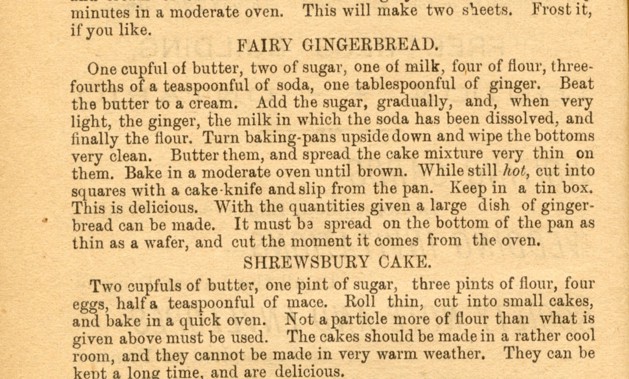
The Art of Cooking Made Easy published by W.A. Karn, Druggist, of Woodstock ca. 1910
Another fun fact surrounding the history of gingerbread cookies is that Queen Elizabeth I is credited with the idea of shaping the cookies to resemble dignitaries visiting her court. However, the cookie known as the “gingerbread man” didn’t officially emerge until the 19th century, with stories such as “The Gingerbread Boy” becoming popular children’s literature.
As Christmas traditions evolved, cookies took on a central role in holiday celebrations. The Protestant Reformation in the 16th and 17th centuries shifted Christmas from a strictly religious observance to a time for family gatherings, feasting, and shared joy. This newfound focus on togetherness allowed festive treats to flourish. By the late 17th century, tin cookie cutters revolutionized holiday baking, turning cookies into intricate, edible works of art as well as gifts for loved ones.
Aunt Lizzies Sugar Cookies
2 cups granulated sugar, 1 cup of lard and butter mixed, 2 eggs, 1 cup sour milk, 1 teaspoon soda (heaping), 1 teaspoon ginger, ½ teaspoon grated nutmeg, mix with spoon and put enough flour so that it won’t stick to hands; roll ½ thick. Bake in moderate oven. – Mrs. Angus Morrson, Woodstock Cookbook, St. Marys Church 1917
Krinkles
½ cup butter, ½ cup shortening, 1 cup brown sugar ½ teaspoon salt, ½ teaspoon vanilla, 2 cups flour, 2 cups rolled oats, 1 teaspoon soda, dissolved in warm water. Cream butter, shortening and sugar, mix salt, flour, and rolled oats. Add alternatively with the dissolved soda, roll in balls and flatten with a fork – Mrs. V.J. Ross, Victory Cook Book, Woodstock Knox Presbyterian Church, WWII
The Industrial Revolution of the 19th century further democratized baking, making essential ingredients like sugar and flour more affordable and accessible to a broader range of households. In North America, it is said that immigrant communities introduced traditional European recipes, which merged with local influences to give rise to the iconic sugar cookie
By the 20th century, the introduction of gas ranges and refrigeration allowed for more sophisticated ingredients and recipes and Christmas baking became solidified as a yearly tradition for many.
Xmas Cookies:
1 cup butter or margarine ½ cup candied cherries (chopped)
1 cup brown sugar 1 cup chopped dates
1 egg 2 cups flour
½ tsp. salt 1 tsp. soda (mix with flour)
1 tsp. vanilla ½ cup chopped walnuts
Mix everything together and form into small balls and flatten with a fork or the bottom of a glass, then sprinkle with white sugar. Bake in slow over at 300° - 225°
Recipe credit: CKOX Party Line: Hints and Recipes for the Homemaker, Volume 3. – 1965.
Nettie and Em’s Old-Fashioned Shortbread
½ lb. butter
1 cup light brown sugar
½ lb. lard
Approx. 4 cups all-purpose flour
Method: cream butter and lard and add sugar. Gradually add flour and kneed until it cracks. More flour could be needed. Roll out and cut into desired shapes. Bake in moderate oven until just light golden colour – Mrs. Cecil Cadwell, Drumbo W.I., Our Anniversary Album of Recipes, Oxford North District Women’s Institute, 1980.
Rudolph Cookies
½ cup butter or margarine
1 3-oz. pkg. cream cheese, softened
1 tsp. vanilla
1 cup all-purpose flour
Red jam
Method: beat butter, cream cheese, and vanilla until well blended. Gradually stir in flour. Turn dough out on a floured surface and shape into a 12” log (dough will be soft). Wrap in wax paper and chill overnight. Cut into ¼” slices and top each with ½ tsp. of jam. Bake on an ungreased cookie sheet for 15 minutes or until bottoms are lightly browned. Oven temperature 350 degrees F. – Janet Lange, Brooksdale W.I., Our Anniversary Album of Recipes, Oxford North District Women’s Institute, 1980.
Finally, although it has its roots in the celebrations of Saint Nicholas, historians believe the tradition of leaving cookies for Santas began to become popular during the Great Depression, as parents wanted to encourage generosity in their children.
Oxford County Archives Staff wishes you and yours a very happy holiday season!